curator Lucie Kukačková
Veronika Holcová has carved out a very distinctive position for herself through her visual expression. She is not swayed by trends and does not allow herself to be constrained by current tendencies. Instead, she confidently shapes her own imaginative universe—a multilayered landscape that springs from dreams, the subconscious, and long-buried memories. Her artistic language avoids established categories and subtly undermines our natural need to clearly name things.
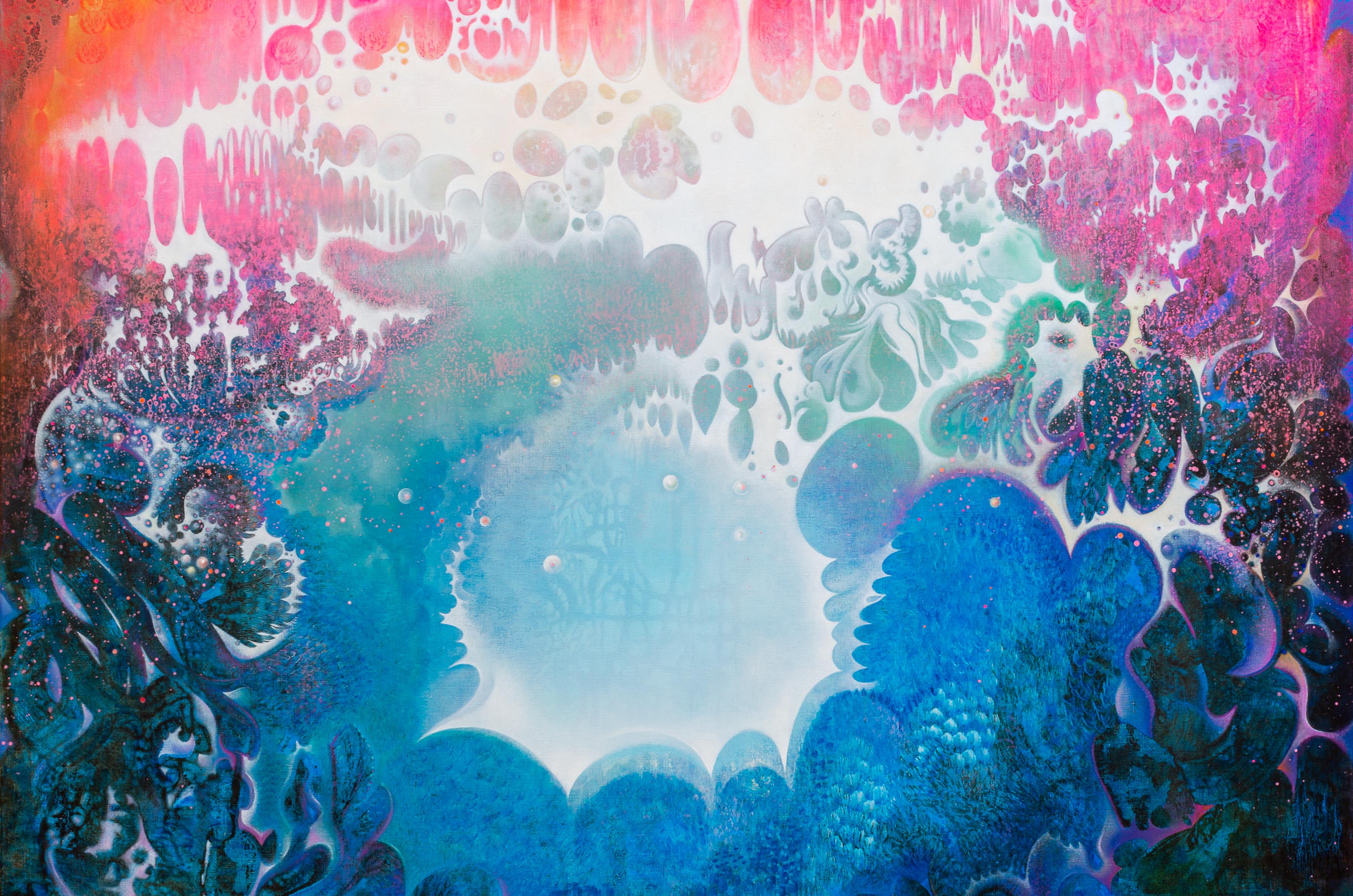
When viewed through this lens, her paintings and drawings presented in the exhibition Above the World in the Underworld take on a paradoxically remarkable dimension in the context of the venue. Gallery 105 is anchored in the heart of Třeboň. For centuries, the local water landscape has been defined by humanity’s efforts to impose a rigid order upon it—to confine the water within solid banks and force it into designated channelFor Veronika Holcová, the exhibition in Třeboň is a deeply personal return. This is where her ancestors came from, and her childhood memories are tied to this environment. These memories resonate in the very title of the exhibition, which can be read as a reference to both the artist’s own history and the imaginative landscape in her paintings. On a personal level, it recalls the moments when she looked down from the top of Třeboň’s high-rise building onto the surface of Svět Pond. This safe, detached view from above—the feeling of being “above Svět”—is, however, immediately turned upside down. Her canvases inevitably draw us into a completely different space, an imaginary underworld where pure intuition reigns.
The starting point for Veronika Holcová’s paintings is often a mere stain, a free expansion of color. From this, she gradually allows further layers of the story she wishes to tell to emerge to the surface. Harmonious scenes blend with dreams, reminiscences, instinct, and a peculiar melancholy, opening up a space filled with unsettling tension. One possible source of this tension is her painterly style, which is based on a rare symbiosis. On the one hand, there is an immediate automatism that springs from the deepest layers of the human psyche and is often associated with Surrealism; on the other hand, there is a refined painting technique, confidence, and precision. Veronika Holcová does not transfer the external, visible world onto the canvas. Her paintings are often visual metaphors for the innermost states of mind.
Veronika Holcová’s work, by contrast, is a phenomenon that flows with natural ease beyond the boundaries of established definitions. In her paintings, she does not urge us to observe the situation reflected on the surface, but to undertake a much bolder and more dangerous act—to dive deeper, beneath the visible surface of the image.
Just as organically as these inner worlds transform, the artist approaches the paintings themselves—she does not treat them as a closed chapter. For her, painting is not a fixed record of a moment, but a process—an open dialogue that can be reignited at any time. She routinely subjects her older works to new experiments and overlays them with additional layers. The original motifs do not disappear; they become part of the memory of the entire work.
In the gallery’s attic, the boundary between the hidden and the visible ceases to be a mere motif—it becomes an almost immersive experience. Here, the installation departs from traditional gallery lighting and submits to the shifting dynamics of light and darkness. The luminescent pigments the artist uses in her paintings emerge from the dim light only for fleeting moments. We are confronted with the limits of rational observation, and a sense of uncertainty sets in—can we penetrate the essence of the painting only when we relinquish the need to have full control over what we see? Here, darkness is not the absence of light, but a necessary space for its inner resonance. The painting becomes a visual echo of what happens within us when we close our eyes tightly.